Job and Ecclesiastes
Job, Ecclesiastes, Song of Songs, Lamentations
22.1. Job
Theme: Will anyone fear God “for nothing,” that is, without interest in reward or punishment? Yes, but when tragedy strikes, lament—not dogmatic traditions of retribution—may be the most appropriate human response.
Outline and Setting.
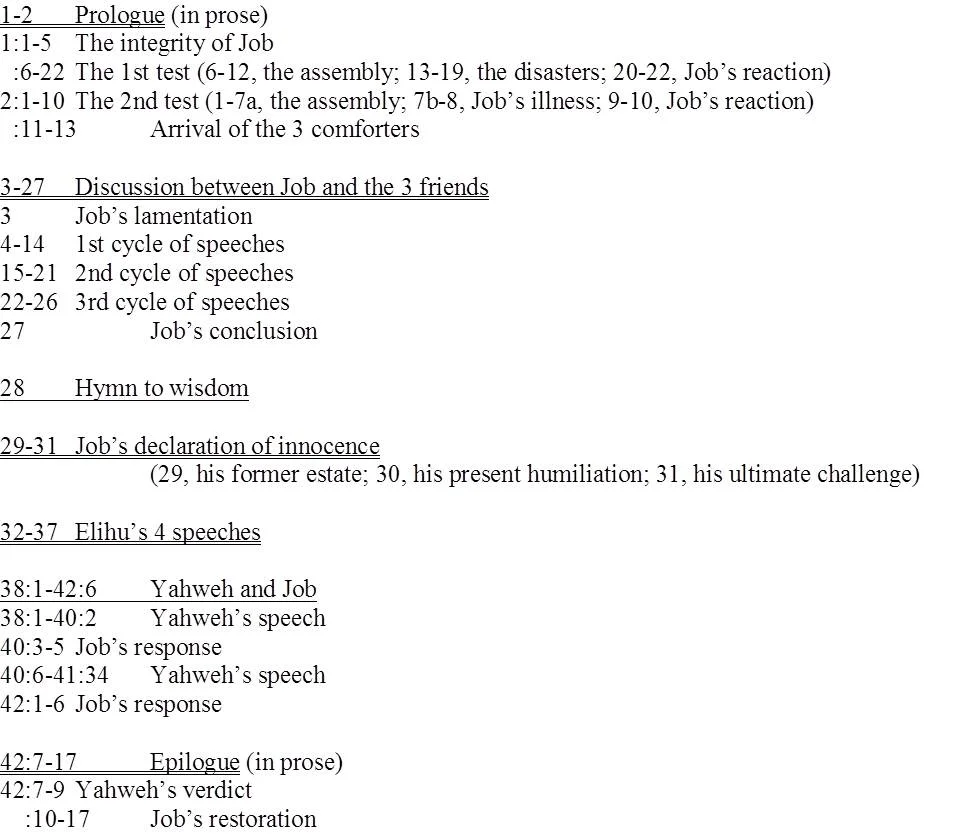
As already noted above in the previous module, Job comes from “the land of Uz” and was considered “the greatest of all the people of the east” (Job 1:1, 3). Job’s comforters are Eliphaz the Temanite, Bildad the Shuhite, and Zophar the Naamathite (Job 2:11)—none of whom are Israelite. The prose prologue and epilogue frame the poetic speeches of Job and his friends as they debate their diagnoses of and prescriptions for Job’s condition. While the sacred name “Yahweh” is familiar to the story’s narrator in the prose sections, Job and his friends never use it in their poetic speeches. Instead, they use more generic forms for “God” (Elohim, Eloah, El) or forms that were originally foreign imports, such as Shadday (usually translated “Almighty”). In other words, Job was not an Israelite, nor did he know the name by which he was saved. Nonetheless, their theological perspective is certainly not typical of the ANE, as it is clearly monotheistic.
The libraries of the ANE, especially in Mesopotamia, contain several literary works with their own “Job” figures and stories: the Sumerian, “Man and his God,” and the Akkadian, “Dialogue between a Man and his God,” “A Sufferer’s Salvation,” “The Poem of the Righteous Sufferer (“I will praise the Lord of wisdom”),” and “The Babylonian Theodicy.” It is very possible that a Yahwistic wisdom sage has taken a familiar ANE theme and reworked it from a monotheistic perspective.
Prose Prologue (Job 1–2): Setting the Stage. The narrator describes Job as “blameless and upright, one who feared God and turned away from evil” (Job 1:1, ESV). Christian readers may tend to think this is overstatement, but seven verses later Yahweh provides an identical endorsement (Job 1:8). The number of his sons (7) and daughters (3), along with the number of the sheep (7000) and camels (3000), are highly symbolic of his impeccability (Job 1:2–3). Beyond this, he also covered for the possible sins of his children by offering sacrifice (Job 1:4–5).
Suddenly in the next passage readers are transported into Yahweh’s heavenly council, where “the sons of God” (the divine beings serving as the divine king’s attendance) “present themselves” (i.e., “take their stand”) and give their report to Yahweh. (In heavenly council type scenes, the royal presider “sits” and his attendants “stand,” as in 1 Kgs 22:19.) “Among them” is “the satan” (in each case the Hebrew text has a definite article). To understand is OT narrative, Christians must recalibrate their expectations of who exactly this figure is. (To this extent, the English translation, “Satan,” is misleading.) Elsewhere in the OT the Hebrew term, satan, is applied to a human military adversary (1 Sam 29:4; 1 Kgs 5:18; 11:14, 23, 25). In the Balaam narrative, Balaam’s “adversary” (satan) is none other than “the Angel of Yahweh” (Num 22:22, 32). In the Psalms, satan refers to an “accuser,” that is a prosecutor in a legal trial (Ps 109:6–7). The closest parallel to this passage in Job is Zechariah 3:1–5, a prophetic vision where the high priest Joshua (not the same figure as in the book of Joshua, but a postexilic high priest) stands on trial in Yahweh’s heavenly court. “The satan is standing at his right hand to accuse” (satan as a verb) him,” as the court’s prosecuting attorney. “The angel of Yahweh” serves as his defense attorney. It is likely he who appeals to Yahweh as the presiding judge, “May Yahweh rebuke you, O accuser” (Zech 3:2). The vision is clear that Joshua is indeed guilty (Zech 3:3–4) so the accusations of “the accuser” (the satan) were not false. These parallels from Zechariah help us to make sense of “the satan’s” reply to Yahweh’s question in the book of Job, “From where do you come?”: “From roving on the earth and walking back and forth on it (Job 1:7). Zechariah 4:10 refers to “the eyes of Yahweh that rove about in all the earth” (Zech 4:10). Here and in Job 1 “the satan” is portrayed in the legitimate role of District Attorney (the DA) in Yahweh’s heavenly court, as he seeks cases that the state should prosecute.
It is in this context that Yahweh brings Job to the DA’s attention:
And Yahweh said to the Accuser, “Have you considered my servant Job, for there is none like him on the earth, an upright man of integrity, a fearer of God, who turns from evil?” (Job 1:8)
In other words, “against my servant, you have nothing to prosecute.” This explains the Accuser’s response: “Does Job fear God for nothing?” (Job 1:9, i.e., “without cause/compensation”). He wagers that Job fears God simply because God protects his household and makes him wealthy, and so he offers this dare, “Stretch out your hand and touch all that he has come and he will surely curse you to your face” (Job 1:9–11). Yahweh then agrees to the challenge, with the condition that he not touch Job himself (Job 1:12).
Ironically, the quest of the book of Job is put into the mouth of the Accuser: Does anyone fear God without interest in gaining reward and avoiding punishment? The book of Job poses a very different question than one applied in the book of Proverbs. Many Proverbs offer reward of blessing for those that choose the way of wisdom () and punishment for those who choose the way of folly (). This mode of pedagogy reflects “interested righteousness,” that is, the pursuit of righteousness with an interest in payback. The book of Job, on the other hand, raises the question of “disinterested righteousness,” that is, the pursuit of righteousness, or in this case the fear of God, for its own sake. The stage is set for Job as a test case.
Job 1:13–22 returns us to the earthly scene, and narrates a series of four tragedies that befall Job’s children and his possessions. The first and the third stem from human agents, and the second and fourth stem from nature (what insurance agents today call “acts of God”—phrasing that is apparently shared by the biblical narrator, “fire of God … from the heavens/skies,” Job 1:16). The narration is formulaic: in each case a single messenger concludes his report saying, “Only I alone have escaped to tell you,” after which, “yet while this one was speaking, another came and said” his report. Job’s response is to go into mourning and to worship saying,
Naked I went forth from my mother’s womb,
and naked I shall return there.
Yahweh has given, and Yahweh has taken;
let Yahweh’s name be blessed (Job 1:21).
(This is the single case where Job uses the name of “Yahweh,” in contrast to his speeches in the poetic sections.)
Chapter 2 again catapults the audience to the heavenly scene, which begins with the same word for word narration found in Chapter 1, where “the sons of God” come to report to Yahweh (Job 2:1–3). Yahweh makes clear that he has won round one:
He still holds fast to his integrity, and you incited me against him to devour him without cause (Job 2:3, the same phrase used in Job 1:9).
Yahweh is clear: he has harmed Job without just cause at the Accuser’s instigation. The Accuser wants to go second round, but this time being allowed to plague Job’s health (Job 2:4–6).
We then return to the earthly scene, where the Accuser then “struck Job with a severe inflammation/boils from the soul of his foot to the crown of his head” (Job 2:7). The scene closes with the arrival of Job’s three friends:
They made an appointment together to come to grieve with him and to comfort him. And they lifted their eyes from a distance, but they did not recognize him. And they lifted their voices and wept, and they each tore their robes and scattered dust heavenward upon their heads. And they sat with him on the ground for seven days and seven nights, and no one spoke a word to him, for they saw that his pain was very great (Job 2:11–13).
►► (Between these double bullets [the sections on the arguments of Job and his friends], focus on the brief introductory summaries.)
The Arguments of Job’s Friends. A synopsis:
They claim to rely on the traditions of the fathers, thus implying that Job relies only on his own experience.
Job 8:8 “Please inquire of past generations, And consider the things searched out by their fathers. 9 “For we are only of yesterday and know nothing, Because our days on earth are as a shadow. 10 “Will they not teach you and tell you, And bring forth words from their minds?
Job 15:10 “Both the gray-haired and the aged are among us, Older than your father.
They have a high view of God’s transcendence.
Job 11:7 “Can you discover the depths of God? Can you discover the limits of the Almighty? 8 “They are high as the heavens, what can you do? Deeper than Sheol, what can you know? 9 “Its measure is longer than the earth And broader than the sea.
But they have a correspondingly low view of humanity.
Job 4:17 ‘Can mankind be just before God? Can a man be pure before his Maker? 18 ‘He puts no trust even in His servants; And against His angels He charges error. 19 ‘How much more those who dwell in houses of clay, Whose foundation is in the dust, Who are crushed before the moth! 20 ‘Between morning and evening they are broken in pieces; Unobserved, they perish forever. 21 ‘Is not their tent-cord plucked up within them? They die, yet without wisdom.’ (Cf. 15:14-16.)
Job 22:2 “Can a vigorous man be of use to God, Or a wise man be useful to himself? 3 “Is there any pleasure to the Almighty if you are righteous, Or profit if you make your ways perfect?
Job 25:1 Then Bildad the Shuhite answered, 2 “Dominion and awe belong to Him Who establishes peace in His heights. 3 “Is there any number to His troops? And upon whom does His light not rise? 4 “How then can a man be just with God? Or how can he be clean who is born of woman? 5 “If even the moon has no brightness And the stars are not pure in His sight, 6 How much less man, that maggot, And the son of man, that worm!” (Contrast Ps 8.)
They view suffering as divine discipline.
Job 5:17 “Behold, how happy is the man whom God reproves, So do not despise the discipline of the Almighty. 18 “For He inflicts pain, and gives relief; He wounds, and His hands also heal.
They assert that it is the evil who suffer, not the innocent.
Job 4:7 “Remember now, who ever perished being innocent? Or where were the upright destroyed? 8 “According to what I have seen, those who plow iniquity And those who sow trouble harvest it. 9 “By the breath of God they perish, And by the blast of His anger they come to an end.
They are certain that the wicked do not get away with their schemes.
Job 18:5 “Indeed, the light of the wicked goes out, And the flame of his fire gives no light. 6 “The light in his tent is darkened, And his lamp goes out above him. 7 “His vigorous stride is shortened, And his own scheme brings him down. 8 “For he is thrown into the net by his own feet, And he steps on the webbing. 9 “A snare seizes him by the heel, And a trap snaps shut on him. 10 “A noose for him is hidden in the ground, And a trap for him on the path. 11 “All around terrors frighten him, And harry him at every step. 12 “His strength is famished, And calamity is ready at his side. 13 “His skin is devoured by disease, The firstborn of death devours his limbs. 14 “He is torn from the security of his tent, And they march him before the king of terrors. 15 “There dwells in his tent nothing of his; Brimstone is scattered on his habitation. 16 “His roots are dried below, And his branch is cut off above. 17 “Memory of him perishes from the earth, And he has no name abroad. 18 “He is driven from light into darkness, And chased from the inhabited world. 19 “He has no offspring or posterity among his people, Nor any survivor where he sojourned. 20 “Those in the west are appalled at his fate, And those in the east are seized with horror. 21 “Surely such are the dwellings of the wicked, And this is the place of him who does not know God.”
Bildad is not too subtle above in how his generic description of the fate of the wicked bears a striking resemblance to Job’s current circumstances (note the italics above)!
Job 20:4 “Do you know this from of old, From the establishment of man on earth, 5 That the triumphing of the wicked is short, And the joy of the godless momentary? 6 “Though his loftiness reaches the heavens, And his head touches the clouds, 7 He perishes forever like his refuse; Those who have seen him will say, ‘Where is he?’ 8 “He flies away like a dream, and they cannot find him; Even like a vision of the night he is chased away. 9 “The eye which saw him sees him no longer, And his place no longer beholds him. 10 “His sons favor the poor, And his hands give back his wealth. (See also vv. 11–29; 15:20-35.)
They make accusations that Job really is wicked.
Job 22:4 “Is it because of your reverence that He reproves you, That He enters into judgment against you? 5 “Is not your wickedness great, And your iniquities without end? 6 “For you have taken pledges of your brothers without cause, And stripped men naked. 7 “To the weary you have given no water to drink, And from the hungry you have withheld bread. 8 “But the earth belongs to the mighty man, And the honorable man dwells in it. 9 “You have sent widows away empty, And the strength of the orphans has been crushed. 10 “Therefore snares surround you, And sudden dread terrifies you, 11 Or darkness, so that you cannot see, And an abundance of water covers you. (Contrast Job’s assertion of innocence in 29:11-17.)
Their prescription: Job needs to confess.
Job 8:5 “If you would seek God And implore the compassion of the Almighty, 6 If you are pure and upright, Surely now He would rouse Himself for you And restore your righteous estate. 7 “Though your beginning was insignificant, Yet your end will increase greatly.
Job 11:13 “If you would direct your heart right And spread out your hand to Him, 14 If iniquity is in your hand, put it far away, And do not let wickedness dwell in your tents;
Job 22:21 “Yield now and be at peace with Him; Thereby good will come to you. 22 “Please receive instruction from His mouth And establish His words in your heart. 23 “If you return to the Almighty, you will be restored; If you remove unrighteousness far from your tent, 24 And place your gold in the dust, And the gold of Ophir among the stones of the brooks, 25 Then the Almighty will be your gold And choice silver to you. 26 “For then you will delight in the Almighty And lift up your face to God. 27 “You will pray to Him, and He will hear you; And you will pay your vows. 28 “You will also decree a thing, and it will be established for you; And light will shine on your ways. 29 “When you are cast down, you will speak with confidence, And the humble person He will save. 30 “He will deliver one who is not innocent, And he will be delivered through the cleanness of your hands.”
They believe Job undermines piety.
Job 15:4 “Indeed, you do away with reverence And hinder meditation before God. 5 “For your guilt teaches your mouth, And you choose the language of the crafty. 6 “Your own mouth condemns you, and not I; And your own lips testify against you.
Job’s Arguments: God’s power. He declares the awesome omnipotence of God.
Job 12:7 “But now ask the beasts, and let them teach you; And the birds of the heavens, and let them tell you. 8 “Or speak to the earth, and let it teach you; And let the fish of the sea declare to you. 9 “Who among all these does not know That the hand of the LORD has done this, 10 In whose hand is the life of every living thing, And the breath of all mankind?
13 “With Him are wisdom and might; To Him belong counsel and understanding. 14 “Behold, He tears down, and it cannot be rebuilt; He imprisons a man, and there can be no release. 15 “Behold, He restrains the waters, and they dry up; And He sends them out, and they inundate the earth. 16 “With Him are strength and sound wisdom, The misled and the misleader belong to Him. 17 “He makes counselors walk barefoot And makes fools of judges. 18 “He loosens the bond of kings And binds their loins with a girdle. 19 “He makes priests walk barefoot And overthrows the secure ones. 20 “He deprives the trusted ones of speech And takes away the discernment of the elders. 21 “He pours contempt on nobles And loosens the belt of the strong. 22 “He reveals mysteries from the darkness And brings the deep darkness into light. 23 “He makes the nations great, then destroys them; He enlarges the nations, then leads them away. 24 “He deprives of intelligence the chiefs of the earth’s people And makes them wander in a pathless waste. 25 “They grope in darkness with no light, And He makes them stagger like a drunken man.
God’s ordering of creation is mysterious.
Job 26:6 “Naked is Sheol before Him, And Abaddon has no covering. 7 “He stretches out the north over empty space And hangs the earth on nothing. 8 “He wraps up the waters in His clouds, And the cloud does not burst under them. 9 “He obscures the face of the full moon And spreads His cloud over it. 10 “He has inscribed a circle on the surface of the waters At the boundary of light and darkness. 11 “The pillars of heaven tremble And are amazed at His rebuke. 12 “He quieted the sea with His power, And by His understanding He shattered Rahab. 13 “By His breath the heavens are cleared; His hand has pierced the fleeing serpent. 14 “Behold, these are the fringes of His ways; And how faint a word we hear of Him! But His mighty thunder, who can understand?”
He dreads God’s scrutinizing presence.
Job 7:17 “What is man that You magnify him, And that You are concerned about him, 18 That You attend to him every morning And try him every moment? 19 “Will You never turn Your gaze away from me, Nor let me alone until I swallow my spittle? 20 “Have I sinned? What have I done to You, O watcher of men? Why have You set me as Your target, So that I am a burden to myself? 21 “Why then do You not pardon my transgression And take away my iniquity? For now I will lie down in the dust; And You will seek me, but I will not be.” (NASB)
(= a parody of Ps 8:4)
Job 14:6 “Turn Your gaze from him that he may rest, Until he fulfills his day like a hired man.” (Cf. Ps 39:13.)
He believes that no one, including himself, can dispute with God: he is too powerful.
If one wished to contend with him, one could not answer him once in a thousand times.
If I summoned him and he answered me, I would not believe that he was listening to my voice. For he crushes me with a tempest and multiplies my wounds without cause;
If it is a contest of strength, behold, he is mighty! If it is a matter of justice, who can summon him?” (Job 9:3, 16–17, 19).
Job: God’s justice. Job desires to know what charges God has against him and is perplexed why God would turn on the work of his hands.
Job 10:2 “I will say to God, ‘Do not condemn me; Let me know why You contend with me. 3 ‘Is it right for You indeed to oppress, To reject the labor of Your hands, And to look favorably on the schemes of the wicked? 8 ‘Your hands fashioned and made me altogether, And would You destroy me? 9 ‘Remember now, that You have made me as clay; And would You turn me into dust again?
God destroys both the blameless and the wicked alike.
Job 9:21 “I am guiltless; I do not take notice of myself; I despise my life. 22 “It is all one; therefore I say, ‘He destroys the guiltless and the wicked.’ 23 “If the scourge kills suddenly, He mocks the despair of the innocent. 24 “The earth is given into the hand of the wicked; He covers the faces of its judges. If it is not He, then who is it?
Job observes that some wicked do prosper.
Job 12:5 “He who is at ease holds calamity in contempt.”
Job 21:7 “Why do the wicked still live, Continue on, also become very powerful? 8 “Their descendants are established with them in their sight, And their offspring before their eyes, 9 Their houses are safe from fear, And the rod of God is not on them. 10 “His ox mates without fail; His cow calves and does not abort. 11 “They send forth their little ones like the flock, And their children skip about. 12 “They sing to the timbrel and harp And rejoice at the sound of the flute. 13 “They spend their days in prosperity, And suddenly they go down to Sheol. 14 “They say to God, ‘Depart from us! We do not even desire the knowledge of Your ways. 15 ‘Who is the Almighty, that we should serve Him, And what would we gain if we entreat Him?
Job raises the question of life after death.
Job 14:7 “For there is hope for a tree, When it is cut down, that it will sprout again, And its shoots will not fail. 8 “Though its roots grow old in the ground And its stump dies in the dry soil, 9 At the scent of water it will flourish And put forth sprigs like a plant. 10 “But man dies and lies prostrate. Man expires, and where is he? 11 “As water evaporates from the sea, And a river becomes parched and dried up, 12 So man lies down and does not rise. Until the heavens are no longer, He will not awake nor be aroused out of his sleep. 13 “Oh that You would hide me in Sheol, That You would conceal me until Your wrath returns to You, That You would set a limit for me and remember me! 14 “If a man dies, will he live again? All the days of my struggle I will wait Until my change comes. 15 “You will call, and I will answer You; You will long for the work of Your hands. 16 “For now You number my steps, You do not observe my sin. 17 “My transgression is sealed up in a bag, And You wrap up my iniquity.
Job’s case before God. Job desires an arbiter.
Job 9:32 “For He is not a man as I am that I may answer Him, That we may go to court together. 33 “There is no umpire between us, Who may lay his hand upon us both. 34 “Let Him remove His rod from me, And let not dread of Him terrify me. 35 “Then I would speak and not fear Him; But I am not like that in myself.
Job desires to plead his case directly before God, thus showing the personal dimension of his faith.
Job 13:3 “But I would speak to the Almighty, And I desire to argue with God. (See also 13:15-22.)
Job 23:3 “Oh that I knew where I might find Him, That I might come to His seat! 4 “I would present my case before Him And fill my mouth with arguments. 5 “I would learn the words which He would answer, And perceive what He would say to me. 6 “Would He contend with me by the greatness of His power? No, surely He would pay attention to me. 7 “There the upright would reason with Him; And I would be delivered forever from my Judge.
Job rejects simple solutions. He is adamant that to give in to his friends’ arguments would be to deny his integrity.
Job 27:2 “As God lives, who has taken away my right, And the Almighty, who has embittered my soul, 3 For as long as life is in me, And the breath of God is in my nostrils, 4 My lips certainly will not speak unjustly, Nor will my tongue mutter deceit. 5 “Far be it from me that I should declare you right; Till I die I will not put away my integrity from me. 6 “I hold fast my righteousness and will not let it go. My heart does not reproach any of my days.
Job believes that his friends have shown partiality to God.
Job 13:7 “Will you speak what is unjust for God, And speak what is deceitful for Him? 8 “Will you show partiality for Him? Will you contend for God? 9 “Will it be well when He examines you? Or will you deceive Him as one deceives a man? 10 “He will surely reprove you If you secretly show partiality. 11 “Will not His majesty terrify you, And the dread of Him fall on you? 12 “Your memorable sayings are proverbs of ashes, Your defenses are defenses of clay.
Job speaks boldly, sometimes directly to God, saying that God has attacked him ruthlessly.
Job 16:7 “But now He has exhausted me; You have laid waste all my company. 8 “You have shriveled me up, It has become a witness; And my leanness rises up against me, It testifies to my face. 9 “His anger has torn me and hunted me down, He has gnashed at me with His teeth; My adversary glares at me. 10 “They have gaped at me with their mouth, They have slapped me on the cheek with contempt; They have massed themselves against me. 11 “God hands me over to ruffians And tosses me into the hands of the wicked. 12 “I was at ease, but He shattered me, And He has grasped me by the neck and shaken me to pieces; He has also set me up as His target. 13 “His arrows surround me. Without mercy He splits my kidneys open; He pours out my gall on the ground. 14 “He breaks through me with breach after breach; He runs at me like a warrior.
Job 19:6 Know then that God has wronged me And has closed His net around me. 7 “Behold, I cry, ‘Violence!’ but I get no answer; I shout for help, but there is no justice. 8 “He has walled up my way so that I cannot pass, And He has put darkness on my paths. 9 “He has stripped my honor from me And removed the crown from my head. 10 “He breaks me down on every side, and I am gone; And He has uprooted my hope like a tree. 11 “He has also kindled His anger against me And considered me as His enemy. 12 “His troops come together, And build up their way against me And camp around my tent. 13 “He has removed my brothers far from me, And my acquaintances are completely estranged from me. 14 “My relatives have failed, And my intimate friends have forgotten me. 15 “Those who live in my house and my maids consider me a stranger. I am a foreigner in their sight. 16 “I call to my servant, but he does not answer; I have to implore him with my mouth. 17 “My breath is offensive to my wife, And I am loathsome to my own brothers. 18 “Even young children despise me; I rise up and they speak against me. 19 “All my associates abhor me, And those I love have turned against me. 20 “My bone clings to my skin and my flesh, And I have escaped only by the skin of my teeth. 21 “Pity me, pity me, O you my friends, For the hand of God has struck me. 22 “Why do you persecute me as God does, And are not satisfied with my flesh? (See also 27:2; 30:11, 18-23.)
Job has a glimpse of his suffering as purifying.
Job 23:8 “Behold, I go forward but He is not there, And backward, but I cannot perceive Him; 9 When He acts on the left, I cannot behold Him; He turns on the right, I cannot see Him. 10 “But He knows the way I take; When He has tried me, I shall come forth as gold. 11 “My foot has held fast to His path; I have kept His way and not turned aside. 12 “I have not departed from the command of His lips; I have treasured the words of His mouth more than my necessary food. (Cf. v. 10 and 1:10.)
“I know my redeemer lives”.
Job 19:23 “Oh that my words were written! Oh that they were inscribed in a book! 24 “That with an iron stylus and lead They were engraved in the rock forever! 25 “As for me, I know that my Redeemer lives, And at the last He will take His stand on the earth. 26 “Even after my skin is destroyed, Yet from my flesh I shall see God; 27 Whom I myself shall behold, And whom my eyes will see and not another. My heart faints within me!
A poem of wisdom (Job 28). Though humans can mine to the darkest depths of the earth (Job 28:1–11), they cannot find wisdom (Job 28:12-22). God alone can discover it (Job 28: 23–27), and the wisdom that God commits to humans is simply the “fear of the Lord” (Job 28: 28).
Job’s innocence. Job asserts his innocence and the respect others have for him.
Job 29:11 “For when the ear heard, it called me blessed, And when the eye saw, it gave witness of me, 12 Because I delivered the poor who cried for help, And the orphan who had no helper. 13 “The blessing of the one ready to perish came upon me, And I made the widow’s heart sing for joy. 14 “I put on righteousness, and it clothed me; My justice was like a robe and a turban. 15 “I was eyes to the blind And feet to the lame. 16 “I was a father to the needy, And I investigated the case which I did not know. 17 “I broke the jaws of the wicked And snatched the prey from his teeth. (See also vv. 7-10, 21-25; 31:1-40.)
Job’s inconsistencies. Contrast:
“How then can I dispute with him? ... if I summoned him and he responded, ... he would crush me with a storm and multiply my wounds for no reason” (Job 9:14, 16, 17).
“If only I knew where to find him .... Would he oppose me with great power? No, he would not press charges against me” (Job 23:6).
►► (Resume reading all the text below.)
Yahweh’s Speeches. Finally, Yahweh appears to answer Job “from the whirlwind/tempest” (Job 38:1). To be clear, God presents himself, not as a friendly comforter, but as the overwhelming "God of the skies"—intimidating to any human. (Readers should recall what is at stake in this book: fearing God.) Given the protracted human debate, the reader is hopeful that God will now reveal some light. But two things quickly become apparent in the divine speeches. First, their content is about creation, not justice—the central theme of the debates. Second, their literary form is principally the rhetorical question. So while God reveals his majesty, he conceals more than he reveals. Nothing is said about righteousness and justice.
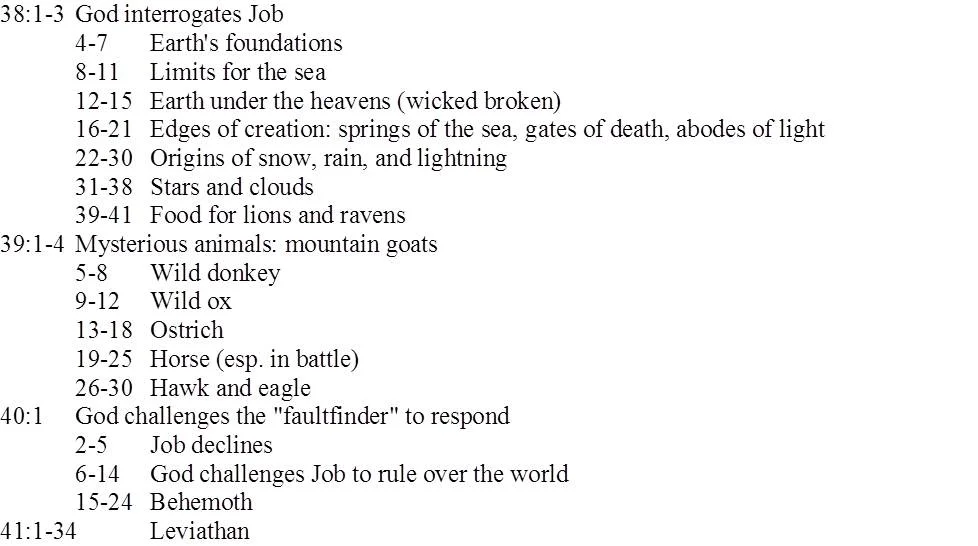
God interrogates Job about the structures of creation (Job 38) and mysterious animals (Job 39). He raises a series of rhetorical questions, sometimes with a sarcastic tone:
“Who is this that darkens counsel by words without knowledge? Dress for action like a man; I will question you, and you make it known to me. “Where were you when I laid the foundation of the earth? Tell me, if you have understanding. Who determined its measurements—surely you know! Or who stretched the line upon it? On what were its bases sunk, or who laid its cornerstone, when the morning stars sang together and all the sons of God shouted for joy? (Job 38:2–7, ESV).
After two chapters of interrogation, Yahweh challenges Job to a legal contest. But he declines, saying that he will speak no further:
And the LORD said to Job: “Shall a faultfinder contend with the Almighty? He who argues with God, let him answer it.” Then Job answered the LORD and said: “Behold, I am of small account; what shall I answer you? I lay my hand on my mouth. I have spoken once, and I will not answer; twice, but I will proceed no further” (Job 40:1–5, ESV).
But Yahweh is not finished with Job. He challenges Job to rule the world and then to rule Behemoth and Leviathan (Job 40–41).
Then the LORD answered Job out of the whirlwind and said: “Dress for action like a man; I will question you, and you make it known to me. Will you even put me in the wrong? Will you condemn me that you may be in the right? Have you an arm like God, and can you thunder with a voice like his? “Adorn yourself with majesty and dignity; clothe yourself with glory and splendor. Pour out the overflowings of your anger, and look on everyone who is proud and abase him. Look on everyone who is proud and bring him low and tread down the wicked where they stand. Hide them all in the dust together; bind their faces in the world below. Then will I also acknowledge to you that your own right hand can save you (Job 40:6–14, ESV).
Finally, Job recants:
And Job answered Yahweh and said: “I know that you can do all things, and that no plan of yours can be thwarted…. I have told what I did not understand, things too wonderful for me, which I did not know…. By the hearing of the ear I had heard of you, but now my eye has seen you; therefore I recant, and repent in dust and ashes” (Job 42:1–6).
With those words the poetic section of the book ends. If the book itself had concluded here, we might have assumed that everything that Job had said was wrong, except perhaps this claim:
If one desired to contest with him in a lawsuit,
one could not answer him once in 1000 times.
If I summoned him, and he answered me,
I would not believe that he was listening to my voice.
Because with a whirlwind he would crush me,
and he would multiply my wounds without cause (Job 9:3, 16–17).
In other words, no human could take out to court and bring a lawsuit against him. A mortal could not hold God accountable.
But nothing could prepare the reader for the Yahwistic narrator’s reversal in the opening verse of the prose epilogue:
After Yahweh had spoken these words to Job, Yahweh said to Eliphaz the Temanite, “My anger burns against you and your two friends, for you have not spoken of me what is trustworthy, like my servant Job” (Job 42:7).
Immediately after Job recants in the poetic dialogues, Yahweh declares in the prose epilogue that Job has spoken of Yahweh what is trustworthy! He instructs the friends to offer sacrifice, and Job is to pray, that is, intercede, for them.
In the epilogue’s closing passage (Job 42:10–17) Yahweh restores Job’s fortune precisely twofold, including 14,000 sheep and 6000 camels. His second set of children, however, numbered the same as the first set: seven sons and three daughters. He saw his children to the fourth generation, and lived 140 years—double a blessed life span.
So how were Job’s words “trustworthy,” while his friends’ words were not? Ironically, the friends attempted to defend God by following the theology reflected in the book of Proverbs, but in their zeal to do so they pressed the logic of their theology too far. In the effort to teach children and disciples, the book of Proverbs uses “if …, then …” statements to teach the principle of just reward: if someone does certain acts, then certain consequences will result (If act → then consequence). But Job’s friends tried to reverse the arrows of logic: if someone experiences these calamities, then he/she must have made foolish/wicked choices (If cursed → then foolish/wicked). In logic, an “if” statement (protasis) and a “then” statement (apodosis) can be reversed only in “if and only if” statements. The claims of the book of Proverbs are appropriate as pedagogy for promoting righteousness and teaching the young to make the best decisions. As noted in the previous Module, they present general observations and offer general conclusions, while some proverbs note there are exceptions to these rules. The disciples of the wisdom sages will have a greater chance of success if they make wise choices. But these pedagogical principles cannot be flipped as a means of judging someone’s character. Clearly factors other than the individual’s choices may have triggered the circumstances that befall them, whether they be beneficial or tragic. In the end the friends attempt at theodicy failed. The book of Job serves as a warning against presumptive judgment of other people.
To identify how Job’s words were “trustworthy” we must observe the principal literary genre by which he speaks, namely that of lament. The book of Psalms testifies to the legitimacy of lament speech to God. Sometimes Job complains bitterly to God, but as noted previously laments need not always be theologically correct to serve as speech that is acceptable to God. Moreover, Job insists on bringing his laments and his legal case directly to God himself.
In the end, the book of Job does not provide readers with a theodicy or answers to life’s big questions. It does not solve the problem of evil, when bad things happen to good people. But it does provide a means of coping when tragedy strikes unfairly, namely to lament before God and to seek an audience with him. Lament and protest, authenticity and honesty—these are the qualities that make Job words “trustworthy.”
Here we must return to the question of whether or not God could be held accountable to upholding justice and fair play. The poetic speeches seem to say, No. But the prose epilogue says, Yes. The disparity between the poetic divine speeches and the prose epilogue brings to light a key biblical tension, where God's accommodated revelation strains to disclose what is appropriate for human interaction with God. One’s theology must always be tempered with pastoral care.
In the whirlwind speeches why does God ignore the primary issues in the human debate, that of justice and retribution? And why does he never inform Job of his “wager” with the Accuser? Because the primary issue of the book of Job is stated in the heavenly council scene and ironically found in the mouth of the Accuser: “Does Job fear God for nothing?” (Job 1:9). According to the “ground rules” of the book, God cannot mention that he upholds justice or reward, otherwise Job would have reason to “fear God”! For Yahweh to succeed, Job must fear him without interest in reward or punishment. And Job can never know about this “test,” especially during the time of trial, but even afterwards because he would then have reason to fear God.
The book of Job is testimony that "fearing God" can persevere even when circumstances do not justify it. When Providence appears to fail and bad things happen to good people (and good things happen to bad people), there is still the possibility, even the necessity, of “fearing God” without interest in gaining reward or avoiding punishment. Pretending to have answers is to go the way of Job’s friends. Job, on the other hand, lamented and sought to have an audience with God. When life is unfair (to Israelites who are forced to live under Gentile empires, to parents who must bury their children, to women who are victims of violence), one can respond to disappointment with the shrug of indifference, by walking away with a sense of betrayal, or by holding on to God “kicking and screaming." This would be a profound message for the Israelites, especially in the hard times of the postexilic period.
Christian readers may not be comfortable with fearing God and prefer to talk about faith in God. But the theology of this book of the Bible is clear: God is king in heaven and creator of the world and its creatures—in all their wonder and complexity. We fear God, simply because he is God. As such, the appropriate human response is "fear," that is, awe and even a sense of holy dread (an attitude that the NT also endorses, Heb 12:28–29; Matt 10:28).
22.2. Ecclesiastes
Theme: Life “under the sun” appears to have no rhyme or reason, but we are to enjoy the gifts that God gives and fear him, for he will judge (somehow).
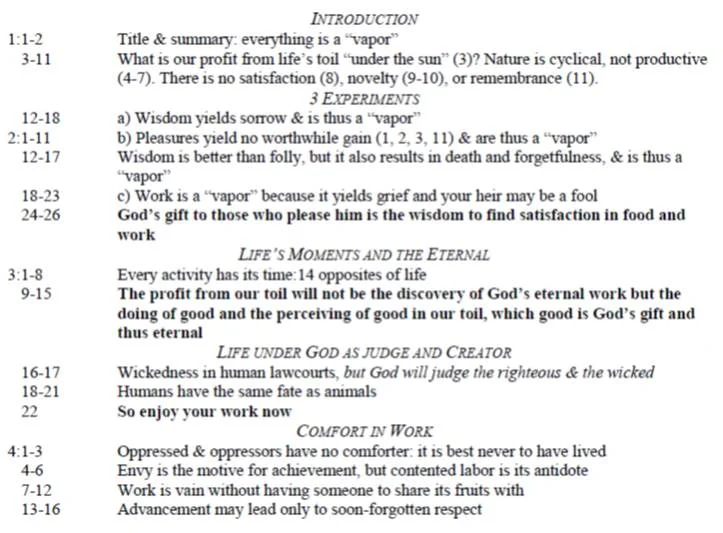
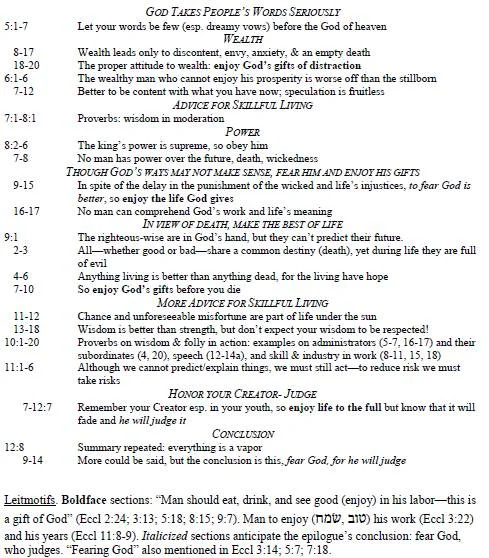
Date and Authorship. The author identifies himself as a royal “son of David” (Eccl 1:1, 12), but his reference to “all who were before me in [or “upon (the throne of)”] Jerusalem” (Eccl 1:16; 2:9) implies that several generations have passed since David. Linguistically, the Hebrew of Ecclesiastes is late postexilic (e.g., the relative pronoun, אֲשֶׁר is written as the prefix שֶׁ‑).
Genre. The book of Ecclesiastes contains a number of internal inconsistencies. For example, the pursuit of wisdom is a “striving after wind” (Eccl 1:17), yet wisdom does have value (Eccl 2:13; 12:11). The stillborn is better off than the prosperous man who cannot enjoy his prosperity (Eccl 6:3; cf. 4:2-3), but anything that lives is better than anything that dies (Eccl 9:4-5). Does the breath return to God? Ecclesiastes 3:18-21 and 12:7 contain contrary perspectives.
One possible explanation is that the book is an edited work, combining the thoughts of both an author and an editor. The exclamations, ’Vanity of vanities,’ says the Preacher, ‘all is vanity!’” (Eccl 1:2; 12:8), serve as bookends, perhaps marking the bounds of Qoheleth’s own work. Ecclesiastes 12:9–14, which refers to Qoheleth in the third person, reads as the editor’s epilogue. The injunction, “fear God and keep his commandments” (Eccl 12:13–14), echoes phrases that are distinctively Deuteronomic (Deut 5:29; 6:2; 8:6; 13:4). It is also possible that the editor’s imprint can also be found within the body of the book.
Another explanation, which may complement the first, is that the body of Qoheleth’s work is a kind of journal. The book may have been a diary in which verses were simply added over the days. Earlier entries were corrected by later ones but left unchanged. Thus, Qoheleth may not have known his conclusion or overarching theme for the book as he wrote each part. The book could represent Qoheleth’s own debate with himself (“torn between what he cannot help seeing and what he still cannot help believing,” Kidner, 91). Transitional phrases support this view. “Then I...” (Heb. “And I (thought) ...”) (Eccl 1:17; 2:12, 15; 3:16, 17, 18; 4:1, etc.). Some portions reflect an inner debate between belief versus experience:
Moreover, I saw under the sun that in the place of justice, even there was wickedness, and in the place of righteousness, even there was wickedness. I said in my heart, God will judge the righteous and the wicked, for there is a time for every matter and for every work (Eccl 3:16–17).
Because the sentence against an evil deed is not executed speedily, the heart of the children of man is fully set to do evil. Though a sinner does evil a hundred times and prolongs his life, yet I know that it will be well with those who fear God, because they fear before him. But it will not be well with the wicked, neither will he prolong his days like a shadow, because he does not fear before God (Eccl 8:11–13).
Another explanation, which may complement the first two, is that the book contains citations of traditional proverbs, juxtaposed by Qoheleth’s reflections. According to the postscript, Qoheleth had “arranged in order” (תקן) many proverbs (Eccl 12:9). Thus, we should not expect the verses to flow as they might from a single author following a single train of thought. Transitions will be lacking. Qoheleth quotes traditional expressions. He then either upholds them, refutes them with his own claims, or reinterprets them by applying an ironic twist. Qoheleth may be teasing us. Ecclesiastes 3:1-8 sounds like quoted material (its poetic style may point to this), upon which Qoheleth comments in Eccl 3:9-14 (note esp. Eccl 3:11). The following passage may initially quote a traditional proverb which is followed by Qoheleth’s own reversals.
A good name is better than precious ointment,
and the day of death than the day of birth.
It is better to go to the house of mourning
than to go to the house of feasting,
for this is the end of all mankind,
and the living will lay it to heart.
Sorrow is better than laughter,
for by sadness of face the heart is made glad (Eccl 7:1–3, ESV).
The opening line sounds like a traditional proverb, one similar to Proverbs 22:1. The portions in italics may be Qoheleth's own reversals with a kind of ironic twist. The two subsequent "for" statements present his reasons for the reversals, the second of which is contrary to Proverbs 15:13.
Ecclesiastes 4:9-12 similarly sounds like a combination of popular proverbs on friendship, to which Qoheleth has added to his reflections on the vanity of work without having someone to share its fruits with (Eccl 4:7-8).
In this respect, Qoheleth may be qualifying traditional wisdom: proverbs that might be taken as absolute statements should, in fact, be interpreted as relative statements. An absolute-sounding statement is made but later statements show it to be valid only from a certain perspective. Qoheleth shows us that other data and viewpoints need to be considered. He thus gives us a realistic picture of life’s ambiguities. Often Qoheleth comes to a positive conclusion, only to then show its downside. For example, wisdom better than folly, but both lead to the same fate (Eccl 2:12-16).
The message of the book. “Vanity”? First, we must be clear on two key terms in the book. The word usually translated, “vanity” (hebel) literally means “breath, vapor.” Its derived meanings refer to “what is evanescent, unsubstantial, or nothing.” Elsewhere in the OT, it is thus used of idols, false gods, or “vain” help or discussions. Its particular usage in Ecclesiastes is clarified by an adjoining phrase: “striving after wind” (Eccl 1:14; 2:11, 17, 26; 4:4, 6; 6:9). As breath and wind are real, but elusive, hebel likely does not denote something like “vanity, worthlessness, meaninglessness, futility,” but rather something that is ungraspable, intangible, an delusive. Our explanations of life are elusive/unsubstantial. Life is a mystery, an enigma. In other words, Qoheleth is not an existential nihilist, but an agnostic. He is not commenting on existence per se, but epistemology.
The antonym of “breath” is often translated “profit” (יִתְרוֹן, יוֹתֵר, “what remains, outcome, profit, gain; advantage”). The first term occurs only in Ecclesiastes (10 times evenly dispersed), and the second, with one exception (Est 6:6), occurs only in Eccl (seven times evenly dispersed). Qoheleth’s ultimate quest is thus to move from the intangible to more substantial answers to the meaning of life.
“Under the sun” life is elusive. Qoheleth, the “Teacher,” takes us through his search for the meaning of life (Eccl 1:12–13). He opens and closes with this conclusion, “‘Breath! Breath!’ says Qoheleth. Everything is breath!’” (Eccl 1:2; 12:8). But the horizons of his investigation must be noted: “under the sun” (Eccl 1:3; 29 times in 27 verses), a perspective is similar to what we would call secularist. Nature and history appear to be a closed system of endless cycles (Eccl 1:3-11). He engages in three experiments. His pursuits of wisdom (Eccl 1:12-18), pleasures (Eccl 2:1-11), and labor (Eccl 2:17-23) all lead to this same conclusion. Throughout the book he shows that life appears vain because, (a) no matter what our efforts in life have been, we all end up at death (Eccl 2:16; 9:2–3); (b) evil and unjust retribution (Eccl 4:3; 7:15; 8:14); (c) so much of life is up to the whim of chance (Eccl 9:11–12).
In Ecclesiastes 3:9-14 the key problem and its partial solution can be seen. God has put eternity in the human heart, but they cannot fathom it. They can only revere God (Eccl 3:14) and be content with what God gives (on this latter point see further Eccl 5:18-20; 9:9-10; also Eccl 2:24-26; 3:12-13, 22; 8:15).
A chief aim of Eccl is to get the readers to take off their rose-colored spectacles of piety and be realistic. Looking at life “under the sun” forces one to see that life is full of anomalies and injustices and to admit that we cannot put it all together. We are forced to face the utter limitations of our own wisdom to find the rhyme and reason of life. Instead, we are to enjoy contentment with the good gifts that God gives (see the parts of the outline in boldface type).
Once Qoheleth has overwhelmed his reader with the despair of ever finding hope “under the sun,” his editor closes with what must be regarded as the only source of hope: God. “Now all has been heard; here is the conclusion of the matter: Fear God and keep his commandments, for this is the whole of man. For God will bring every deed into judgment ...” (Eccl 12:13-14, a conclusion is foreshadowed in Eccl 8:12). Humans must despair of ever achieving a system of wisdom that answers all of life’s questions, and we must resign themselves to “the whole duty of man”—this and nothing more—”fear God and keep his commandments” (Eccl 12:13).
One might be inclined to think of Ecclesiastes as reflecting purely intellectual interests, but in some respects it is perhaps the strongest appeal for the necessity of faith in the Bible. The world itself does not give us reasons to believe life has meaning. A purely rational basis for faith cannot be found. Qoheleth presents us with the enormous gap between a just and meaningful world and a just and meaningful God. Faith is not self-evident. The pursuit of wisdom itself does not lead us to God; we must rely on his revealed commandments and on his character to “bring every deed into judgment” (Eccl 12:14).
Wisdom, though limited, does have value. But Qoheleth is not therefore an advocate of anti-intellectual faith. Pursuit of wisdom does have value and benefits in itself (see, e.g., Eccl 2:13; 4:4-6; 12:11), but we must also recognize our limitations to grasp its total measure. If we simply buy into his conclusion on “the whole duty of man” without walking with him through his search, if we do not feel his frustration, we would lose touch with reality and we would lose a sense of the prize that God’s revealed commandments are. The search is necessary to appreciate the conclusion.
Qoheleth’s conclusion is similar to the one in Job’s “hymn to wisdom” in Job 28. Although humankind can tunnel to the depths of the earth, we cannot find wisdom. Only God can. In the context of the book of Job this “wisdom” must include answers to tough questions that he and his “comforters” are trying to answer, such as why does Job suffer. But the wisdom that God commits to humankind is simply, “The fear of the Lord—that is wisdom, and to shun evil is understanding” (Job 28:28). This “wisdom” does not answer the big questions, but God considers it sufficient for us to live by. Ultimate Wisdom is unattainable, but the wisdom God gives us is to fear him.
As Derek Kidner said so well, “Triviality is more stifling than tragedy, and the shrug is the most hopeless of all comments on life. The function of Ecclesiastes is to bring us to the point where we begin to fear that such a comment is the only honest one. So it is, if everything is dying. We face the appalling inference that nothing has meaning, nothing matters under the sun. It is then that we can hear, as the good news which it is, that everything matters—’for God will bring every deed into judgment, with every secret thing, whether good or evil’ [12:14]” (A Time to Mourn, and a Time to Dance [IVP, 1976] 20). (See also J.I. Packer, Knowing God, chap 10.)